Gameverse TheGameArchives: The Ultimate Guide to the Digital Gaming Vault – Features, History, Benefits & How to Use It
If you have ever tried to find information, artwork, or development history on a video game you loved a decade ago, you know how quickly digital media can vanish. Links break, official websites shut down, and behind-the-scenes developer insights get lost to time. That is exactly where Gameverse TheGameArchives comes into play. As the ultimate digital gaming vault, Gameverse TheGameArchives is an exhaustive, community-driven platform designed to preserve the rich history of video games. Whether you are hunting for nostalgic 8-bit art or researching the unreleased prototypes of modern hits, this platform is the definitive solution for game preservation.
This guide covers absolutely everything you need to know about the platform. We will dive deeply into what it is, how it started, its standout features, and a step-by-step walkthrough on how you can start using it today.
What is Gameverse TheGameArchives?
At its core, Gameverse TheGameArchives is a massive, meticulously categorized digital library dedicated to the preservation and celebration of video game history. Think of it as a hybrid between a digital museum, a highly detailed gaming encyclopedia, and an interactive community hub. It houses millions of records, including box art, original soundtracks, developer design documents, patch notes, and gameplay footage across every era of gaming.
Unlike standard gaming wikis that just offer basic plot summaries, this platform focuses on the context of gaming. It archives the physical and digital footprint of the industry so that future generations can understand how games were made, marketed, and played.
Is Gameverse TheGameArchives a Game Download Site?
Because the word “archive” is in the name, this is one of the most common questions people ask. No, Gameverse TheGameArchives is not an illegal ROM download or piracy site. The platform strictly operates within the bounds of copyright law and fair use. Instead of offering playable, copyrighted game files for download, it provides the historical context surrounding those games. You will find:
- High-resolution scans of original manuals
- Concept art and storyboards
- Audio files of soundtracks and sound effects
- Playable browser-based emulations of open-source or public domain titles (where legally permitted)
- Archival footage of rare gameplay and developer interviews
The goal is education, research, and preservation, not the distribution of copyrighted software.
Who Uses Gameverse TheGameArchives?
Because of its massive scope, the platform attracts a wide variety of users from all corners of the globe:
- Nostalgia Seekers: Gamers wanting to read the manual of a game they rented from Blockbuster in the 1990s.
- Content Creators: YouTubers and streamers looking for high-quality, historically accurate assets for their video essays and documentaries.
- Journalists and Researchers: Writers needing primary sources, release dates, and developer quotes for industry articles.
- Game Developers: Indie creators studying the design documents and mechanics of classic games to inspire their own projects.
The History Behind Gameverse TheGameArchives: How It All Started
To understand the value of this platform, you have to look at the historical crisis that birthed it. Video games are an incredibly fragile medium.
The Problem of Game Preservation: Why It Matters More Than You Think
Unlike books or paintings, video games require specific hardware to be experienced. Over time, that hardware breaks down. Console batteries die, CDs suffer from “disk rot,” and early magnetic tapes degrade.
Furthermore, the shift to digital-only releases has created a new nightmare for historians. When a digital storefront shuts down, or when a live-service game turns off its servers, that game essentially ceases to exist. There is no physical cartridge to put on a shelf. Thousands of early mobile games, browser-based Flash games, and early MMOs (Massively Multiplayer Online games) have already vanished forever. Gameverse TheGameArchives was built to combat this exact problem, to catch the history of gaming before it falls through the digital cracks.
From Idea to Platform: The Evolution of TheGameArchives
The project did not start as the massive, polished database it is today. It began as a fragmented effort by a small group of passionate archivists, speedrunners, and retro collectors on obscure internet forums. These users were tired of seeing their favorite games disappear.
Initially, they shared scanned magazine pages and ripped audio files via basic cloud storage links. However, as the collection grew into terabytes of data, they realized they needed a centralized, organized, and searchable database. Thus, Gameverse TheGameArchives was officially launched. Over the years, thanks to thousands of volunteer contributors and crowdsourced funding, it has evolved from a simple directory into a highly sophisticated, multi-media web platform.
Top Features of Gameverse TheGameArchives That Make It Stand Out
What separates this platform from a standard internet search? It all comes down to its specialized features built specifically for the gaming community.
Massive Game Catalog: From 8-Bit Classics to Modern Indie Gems
The sheer size of the database is staggering. It does not just focus on Nintendo, PlayStation, or Xbox blockbusters. The catalog includes:
- Early Arcade Cabinets: Including vector graphics games and pinball machine schematics.
- Home Computers: MS-DOS, Amiga, Commodore 64, and ZX Spectrum software.
- Obscure Handhelds: Games from the Atari Lynx, WonderSwan, and Neo Geo Pocket.
- Modern Indies: Archiving the patch histories and early Kickstarter campaign promises of modern independent games.
The Prototype Vault: Unreleased Builds & Developer Archives
This is arguably the most exciting feature for hardcore gaming historians. The Prototype Vault contains documentation, screenshots, and sometimes video footage of games that were canceled mid-development.
Have you ever wondered what the sequel to your favorite game would have looked like before the studio went bankrupt? The Prototype Vault pieces together these lost media puzzles using leaked design briefs, interviews with former developers, and recovered beta-test footage.
Multimedia Depth: Art, Music, Video & Developer Interviews
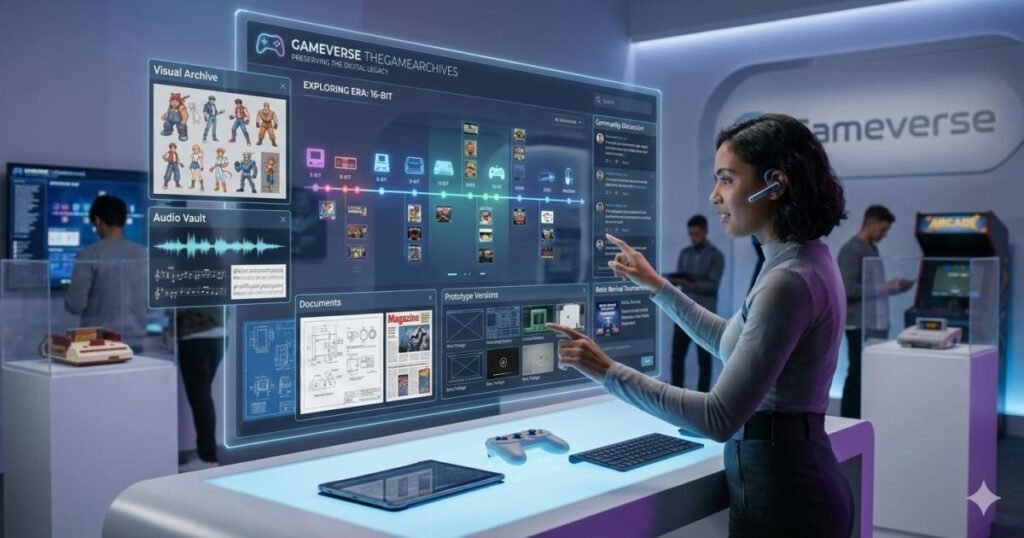
Gameverse TheGameArchives goes beyond text. A single game’s page can contain:
- The Visual Archive: Promo posters, localized box art from different countries (e.g., the difference between Japanese and North American covers), and 3D models.
- The Audio Vault: Uncompressed MIDI files, full orchestral soundtracks, and voice-acting outtakes.
- The Video Library: E3 reveal trailers, old television commercials, and complete, unedited gameplay walkthroughs to show how the game actually played.
Smart Search, Navigation & Personalized Profiles
Navigating millions of files is useless if the search function is clunky. The platform uses an advanced tagging system. You can filter searches by:
- Release year and specific hardware platform.
- Genre and sub-genre (e.g., “Sci-Fi,” “Turn-Based Strategy,” “Cyberpunk”).
- Specific developers, composers, or artists.
Users can also create personalized profiles to track their favorite games, create custom lists (e.g., “Best SNES RPG Soundtracks”), and bookmark pages for later research.
Community Hub: Forums, Contributions & Retro Revival Tournaments
The archive is kept alive by its community. The integrated forums allow users to discuss game lore, share hardware repair tips, and organize “Retro Revival” community events. Furthermore, the platform has a robust contribution system. If you have an old, rare gaming magazine sitting in your attic, you can scan it and submit it to the archive. The community moderators will review it and add it to the permanent database.
How to Use: A Beginner’s Step-by-Step Walkthrough
Getting started with Gameverse TheGameArchives is straightforward. Here is a simple guide to navigating the vault.
- Create a Free Account: While you can browse without an account, signing up allows you to create lists, save bookmarks, and participate in the forums.
- Use the Global Search Bar: Type in the name of a game, developer, or console. Use quotation marks for exact matches (e.g., “Super Mario World”).
- Utilize Advanced Filters: If your initial search yields too many results, use the left-hand sidebar to narrow it down by year, region, or media type (audio, image, text).
- Explore the Game Dashboard: Once you click on a game, you will see a dashboard. Use the top tabs to switch between Overview, Media, Documents, Versions, and Community Discussions.
- Contribute to the Vault: See missing information? Click the “Suggest an Edit” or “Upload Media” button. Follow the strict formatting guidelines to ensure your submission is accepted by the moderation team.
Tips & Tricks for Getting the Most Out of Gameverse TheGameArchives
- Look for Regional Differences: Many games were entirely different depending on whether they were released in the USA, Europe, or Japan. Search for “Regional Differences” under a game’s profile to see translated texts and censored artwork.
- Explore the ‘Random Page’ Button: If you are bored and want to discover something new, hitting the random button is a fantastic way to find obscure 1980s text adventures or forgotten 2000s puzzle games.
- Check the ‘Source Links’: Whenever possible, the archive links back to the original developer’s portfolio or blog, providing great reading material for aspiring designers.
The Real Benefits of Using TheGameArchives (Not Just for Nostalgia)
While the nostalgia factor is a huge draw, the platform offers tangible benefits for various professional and hobbyist groups.
For Retro Gamers & Collectors
For physical game collectors, the archive is a vital tool for verifying authenticity. By looking at high-resolution scans of legitimate game boards and box art, collectors can easily spot fake reproductions being sold online. It also provides the digitized manuals that are often missing from second-hand purchases.
For Game Developers & Designers
It is said that to create something new, you must understand what came before. Modern game developers use the platform to study UI (User Interface) evolution, level design blueprints, and the progression of game mechanics. Reading a post-mortem document from a 1990s development team can help modern indie devs avoid the same pitfalls.
For Historians, Researchers & Students
Video games are a multi-billion-dollar cultural force. Academic researchers studying digital media, sociology, or art history rely on Gameverse TheGameArchives as a primary source. The platform provides proper citation tools, making it easy for university students to reference old gaming magazines and developer interviews in their thesis papers.
For Casual Gamers & Newcomers
You don’t have to be a hardcore historian to enjoy the site. Casual gamers use the platform to find the name of that “one game with the red car” they played as a kid, or simply to listen to relaxing background music from classic RPGs while they work or study.
How Does TheGameArchives Compare to Other Game Archives & Platforms?
The internet has a few different ways of preserving games, but they all serve slightly different purposes. Here is how Gameverse TheGameArchives stacks up against the competition.
| Feature / Platform | Gameverse TheGameArchives | Standard Gaming Wikis | Internet Archive | Digital Storefronts (e.g., Steam/GOG) |
| Primary Focus | Context, history, art, and documentation | Plot summaries and lore | Raw file storage | Selling playable games |
| Multimedia Assets | High (Audio, Video, Scans, 3D Models) | Low (Mostly compressed JPEGs) | High (But difficult to search) | Medium (Modern trailers only) |
| User Interface | Built specifically for gaming categories | Text-heavy | Clunky, broad directory | Store-focused |
| Prototype/Beta Info | Extremely Detailed | Minimal | Very little context provided | None |
What Makes Gameverse TheGameArchives Unique?
What truly sets it apart is the curation and context. The Internet Archive is fantastic, but it is a massive, somewhat chaotic dumping ground for all types of digital media. Finding a specific version of a game manual there can take hours. Gameverse TheGameArchives is laser-focused on gaming, meaning its search algorithms and categorization methods are built specifically for how gamers think and search.
Is TheGameArchives Legal? The Ethics of Game Preservation
Navigating copyright law in the digital age is complex, especially for video games, where the rights might be owned by companies that went bankrupt decades ago.
Gameverse TheGameArchives operates under the principles of Fair Use and historical preservation. Because the platform does not distribute executable game codes (ROMs or ISOs) of commercial games that are actively sold, it avoids stepping on the toes of current copyright holders. The distribution of scans, metadata, reviews, and short gameplay clips falls safely within educational and archival exemptions.
Why Ethical Game Preservation Matters
If we wait for massive corporations to preserve their own history, much of it will be lost. Companies are motivated by profit; if a 20-year-old game isn’t financially viable to port to modern consoles, the publisher will likely lock it away in a corporate vault. Ethical, third-party preservation ensures that art belongs to the culture, not just the corporation, ensuring that the legacy of the artists, coders, and musicians is not forgotten.
What Gaming Trends Does TheGameArchives Cover?
Gaming is not static, and neither is the archive. While it excels at retro preservation, it actively tracks and archives current industry trends.
- The Live-Service Era: Archiving seasonal map changes, limited-time events, and patch notes for games like Fortnite or Destiny, which change weekly.
- Virtual Reality (VR): Documenting the early, experimental days of modern VR mechanics, including control schemes and user interface designs that are rapidly evolving.
- Mobile Gaming: Preserving the history of early smartphone gaming, a medium heavily impacted by constant OS updates that render old apps unplayable.
How Gameverse Uses Technology to Stay Relevant
To handle this massive influx of modern data, the platform uses automated web scrapers to back up developer blogs and social media announcements before they are deleted. It also utilizes community-trained algorithms to help upscale and restore degraded audio and video files from the 1980s, ensuring the highest quality preservation possible.
Final Thoughts
Video games are a crucial pillar of modern entertainment, storytelling, and technological advancement. Losing our gaming history means losing a piece of our global culture. Gameverse TheGameArchives stands as a digital fortress against time, disk rot, and server shutdowns. By combining a massive, deeply categorized database with a passionate community, it has created the ultimate resource for anyone who loves the art of gaming.
Whether you want to research the mechanics of a forgotten arcade cabinet, listen to a classic soundtrack, or just take a walk down memory lane, this platform has exactly what you need.
Ready to explore gaming history? Comment below, create your free profile, join the community forums, and consider contributing a memory or a digital scan today. The preservation of our digital history starts with you!
Frequently Asked Questions
Q1. Is Gameverse TheGameArchives completely free to use?
Yes, the platform is 100% free for all users. It is primarily supported by community donations and volunteer efforts to keep the servers running.
Q2. Can I download and play old games directly from the site?
No. The platform focuses on the history and media surrounding games (manuals, art, music, videos), not the distribution of copyrighted playable ROMs or game files.
Q3. How can I contribute to the archive?
Once you create a free account, you can use the “Upload Media” or “Suggest Edit” buttons on any game’s page. All submissions are reviewed by moderators for accuracy before going live.
Q4. Does the archive include modern console games?
Absolutely. While retro games are a massive focus due to their high risk of being lost, the platform also meticulously tracks modern releases, patch notes, and developer updates for current-gen consoles.
Q5. I found incorrect information about a game. How do I fix it?
Because the site is a collaborative community effort, you can submit an edit request providing the correct information and, ideally, a reliable source to back up your claim.
Q6. Is there a mobile app for Gameverse TheGameArchives?
Currently, the platform is accessed via a highly optimized, mobile-responsive web browser interface, meaning it works perfectly on smartphones and tablets without needing an app download.
Q7. How are unreleased games or prototypes sourced?
Information in the Prototype Vault comes from leaked developer documents, interviews with former staff members, old magazine previews, and assets recovered by the community.
Q8. Can I use the images and music found on the site for my YouTube channel?
Most of the historical media hosted is for educational and archival purposes. While you can generally use it for commentary or review videos under “Fair Use,” you are still responsible for adhering to your local copyright laws.