
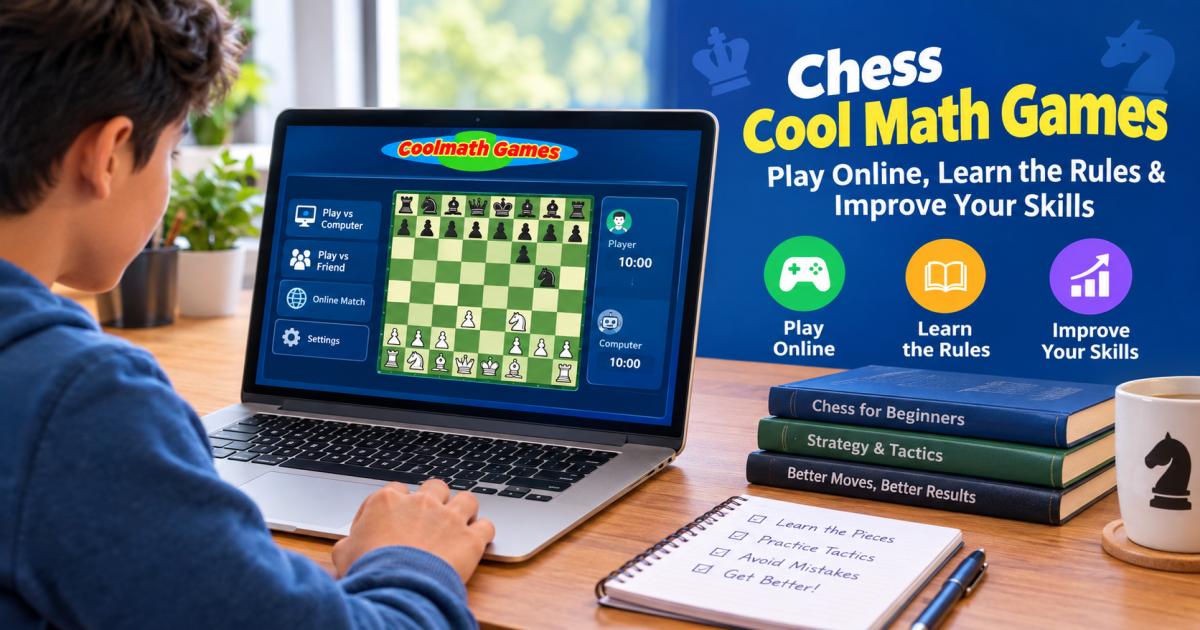
Chess Cool Math Games: Play Online, Learn the Rules & Improve Your Skills
Chess Cool Math Games is the free Chess game on Coolmath Games. You open it in your browser, pick an opponent, and play. You can challenge the computer, a friend, or another online player, and you don’t download anything.
This guide teaches you the full game from zero. The rules come from the Laws of Chess, which FIDE (the World Chess Federation, founded in 1924) publishes. The facts about the game itself come from Coolmath Games’ own pages.
Quick facts
- Cost: Free to play. Ads pay for the site, and a paid ad-free plan exists.
- Opponents: The computer, a friend, or an online player.
- Download needed: No. It runs in a web browser.
- Goal: Trap the other player’s king (checkmate).
- Best first step: Learn how the six piece types move.
What Is Chess Cool Math Games?
Chess Cool Math Games is the standard Chess game on Coolmath Games, a free site of puzzle and strategy games. It follows the normal rules of chess and runs in a web browser.
Coolmath Games calls itself a brain-training site where logic, thinking, and math meet fun, and it says its games have no violence. Chess fits that goal. Every move is a small logic puzzle.
The site also groups a few chess-style games. Its chess page lists Chess, Chessformer, and Space Chess. These are not all the same game:
- Chessformer is a puzzle. You move chess pieces past obstacles to land on a red king.
- Chess Match is a match-three game. You move pieces by their chess rules to line up three of the same kind.
- 4×4 Chess shrinks the board. It was built with Flash, and the site says it doesn’t play in browsers right now.
Start with the standard Chess game. The twists make more sense once you know the real rules.
One more fact for parents. The site has a page that explains how it keeps players safe.
How to Play Chess Cool Math Games Online
To play chess on Coolmath Games, open the site, search for “Chess,” press play, choose your opponent, then click a piece and click the square where it should go.
Screens change over time, so follow the on-screen prompts if they differ from these steps.
- Open Coolmath Games in your browser.
- Search for “Chess” or open the chess category.
- Press play. An ad may run first. Let it finish.
- Pick your opponent: the computer, a friend, or an online player.
- Click one of your pieces. Then click the square you want.
- Keep going until someone is checkmated.
If the game won’t load, refresh the page or try another browser. On a phone or tablet, tap the piece, then tap the square.
Try it now: Play three games against the computer. Give yourself one job in each game: never leave a piece where it can be captured for free.
Chess Board Setup: The Basics You Need to Know
A chess board has 64 squares in 8 rows and 8 columns. Each player starts with 16 pieces, so 32 pieces sit on the board at the start.
The game sets up the board for you. You still need to know the layout for real boards and for chess lessons.
- Board direction: Turn the board so each player has a light square in the bottom right corner. Many players say, “light on the right.”
- Pawns: All eight fill the second row in front of you.
- Back row, corner to corner: Rook, knight, bishop, queen, king, bishop, knight, rook.
- Queen placement: The queen starts on her own color. The white queen sits on a light square. The black queen sits on a dark square.
- First move: White always goes first. Then you take turns.
- Square names: Each square has a letter and a number, like e4. The letter is the column. The number is the row. Chess books and lessons use these names.
Here is a fact that shows how little you need to memorize. White has exactly 20 legal moves on turn one: 16 pawn moves and 4 knight moves.
Chess Pieces and How They Move
Chess has six piece types: king, queen, rook, bishop, knight, and pawn. Each one moves in its own way.
This table shows two things on an empty board. First, each piece’s usual value, in pawns. Second, how many squares it can reach from the center and from a corner.
| Piece | Value | Squares from center | Squares from corner |
| Pawn | 1 | 1–2 forward | 1–2 forward |
| Knight | 3 | 8 | 2 |
| Bishop | 3 | 13 | 7 |
| Rook | 5 | 14 | 14 |
| Queen | 9 | 27 | 21 |
| King | Priceless | 8 | 3 |
Look at the knight and the bishop. A knight on d4 reaches eight squares. The same knight on a1 reaches two. Pieces simply do more in the middle of the board.
King
The king moves one square in any direction. It can never step onto a square that an enemy piece attacks.
If you lose your king, you lose the game. It is weak early on, so most players move it to safety with a special move called castling.
Queen
The queen moves any number of squares in a straight line or on a diagonal. She combines the rook and the bishop. That is why she is worth about nine pawns.
Keep her home early. Enemy knights and bishops can chase her, and you lose time.
Rook
The rook moves any number of squares forward, back, or sideways. It never moves on a diagonal.
Rooks start in the corners and do little at first. They get strong once rows and columns open up. Two rooks on the same row or column protect each other.
Bishop
The bishop moves any number of squares on a diagonal. It stays on one color for the whole game. One of your bishops always travels on light squares, and the other always travels on dark squares.
A pair of bishops covers every square on the board. That is why players try to keep both.
Knight
The knight moves in an L shape: two squares one way, then one square to the side. It is the only piece that jumps over others.
Knights work best near the center. Many beginners miss knight attacks because the L shape feels odd. Slow down and count the squares.
Pawn
Pawns follow the most special rules:
- A pawn moves one square forward. On its first move, it may move two squares.
- A pawn captures one square diagonally forward. It cannot capture straight ahead.
- A pawn never moves backward.
- A pawn that reaches the far row promotes. You swap it for a queen, rook, bishop, or knight. Most players choose a queen.
Because pawns can’t go back, every pawn move is permanent. Think before you push one.
Essential Chess Rules Every Beginner Should Learn
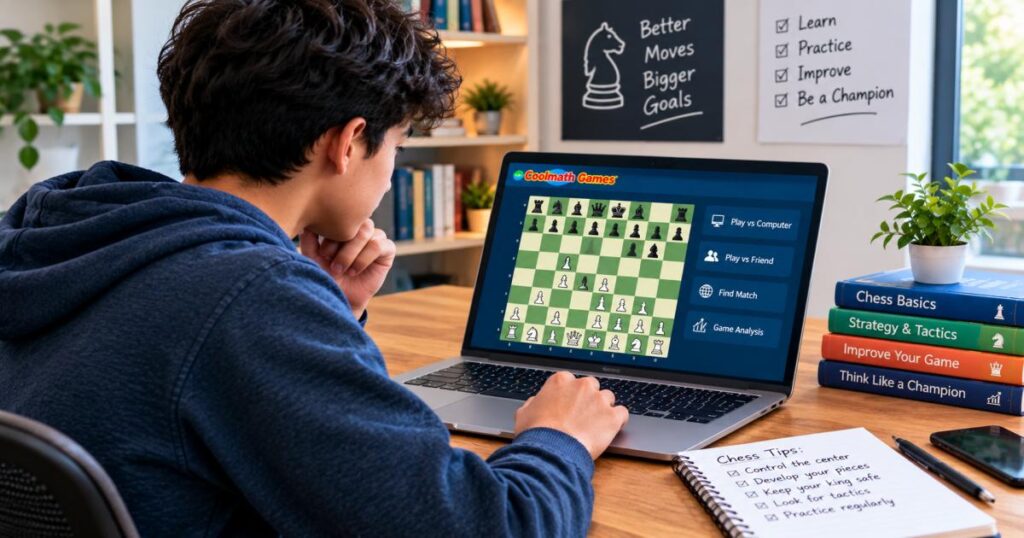
The key rules are: take turns, capture by landing on an enemy piece, never leave your king in check, and win by checkmate. These eight rules cover most games.
- Turns. White moves first. You must make one move on every turn.
- Capturing. Move onto an enemy piece’s square, and that piece leaves the board.
- No jumping. Only the knight can jump over other pieces.
- Check. A king under attack is in check. You must fix it right away. You can move the king, block the attack, or capture the attacker.
- Checkmate. If you are in check and none of those three fixes work, the game ends, and you lose.
- Castling. The king moves two squares toward a rook, and the rook jumps to the other side of the king. You can castle only if neither piece has moved, no pieces sit between them, the king is not in check, and the king does not cross or land on an attacked square.
- En passant. Say an enemy pawn moves two squares and lands beside your pawn. On your next move only, you may capture it as if it had moved one square. The French name means “in passing.”
- Promotion. A pawn that reaches the last row becomes a stronger piece.
A game can also end in a draw. The common ways are:
- Stalemate: You are not in check, but you have no legal move.
- Agreement: Both players agree to a draw.
- Repetition: The same position appears three times.
- The 50-move rule: Fifty moves pass with no capture and no pawn move.
- Too few pieces: Neither side can checkmate. A lone king against a lone king is the plainest example.
Simple online games may not offer every special rule. If a move looks odd, check it against this list.
How Do You Win in Chess Cool Math Games?
You win by checkmate. That means you attack the enemy king, and it has no safe move, no block, and no capture.
To test for checkmate, ask three questions:
- Is the king under attack?
- Can it move to a safe square?
- Can any piece block or capture the attacker?
If the answers are yes, no, no, it is checkmate.
You can also win if your opponent resigns. If the game uses a clock, you win when the other clock runs out.
Real examples of checkmate:
- Fool’s Mate is the shortest possible game. White plays f3 and g4. Black answers with e5 and then Queen to h4. That is checkmate on move two.
- Back-rank mate happens when a king sits on its first row behind its own pawns. Picture a white king on g1 with pawns on f2, g2, and h2. If a black rook lands on e1 and nothing blocks it, the king has nowhere to go.
Two checkmates to learn first:
- Queen and king against a lone king. Use the queen to push the enemy king to the edge. Bring your own king close. Then finish with the queen next to the king, with your king guarding her.
- Two rooks against a lone king. Use the rooks to push the king back one row at a time, like climbing a ladder.
Watch out for stalemate. When you are far ahead, it is easy to leave your opponent with no legal move. That ends the game in a draw, not a win. Before each move, check that the enemy king still has somewhere to go.
Chess Cool Math Games Tips for Beginners
The best beginner tips are: control the center, bring out your knights and bishops, castle early, keep your queen home, and check your opponent’s last move before you move.
- Fight for the center. The squares d4, e4, d5, and e5 give your pieces room. As the table shows, a knight there reaches four times as many squares as one in a corner.
- Develop your knights and bishops. Move them off the back row in the first few moves.
- Castle early. Aim to castle within the first ten moves. It protects your king and brings a rook into play.
- Keep your queen home at first. Early queen moves usually lose time. The Scholar’s Mate trap below shows the danger.
- Don’t move one piece many times in the opening. Bring out a new piece each turn instead.
- Check your opponent’s last move. Ask, “What does it attack?” Beginner games typically end because one side misses a simple threat.
- Protect what you own. Before you click, check that none of your pieces sits unguarded.
- Use the piece values. Trading a rook (5) for a pawn (1) loses four points of value.
- Take your time. Against the computer, you may have no clock. That gives you time to think, so use it.
How to Improve Your Skills While Playing Chess Cool Math Games
To improve at chess cool math games, check for threats before every move, review your losses, learn basic checkmates, and solve a few puzzles each day. How you practice matters more than how long you play.
Use a three-part safety check. Many coaches teach this habit. Before each move, look for:
- Checks: Can I check the enemy king? Can they check mine?
- Captures: What can I capture? What can they capture?
- Threats: What is attacked right now?
The check takes about ten seconds. It stops most of the “free piece” blunders.
Review every loss. After a game, find the move where things went wrong. Was a piece left hanging? Did you miss a threat? Write down the mistake, and look for it next time.
Solve puzzles. A puzzle gives you a position and asks for the best move. It trains your eyes to spot tactics. Lichess offers puzzles for free.
Play different opponents. Try the computer, then a friend, then an online player. When you win often, move up to a stronger opponent.
A simple one-week plan:
- Day 1: Learn how all six pieces move. Play one game.
- Day 2: Practice castling and center control in two games.
- Day 3: Learn the queen and king checkmate.
- Day 4: Solve five puzzles, then play a game.
- Day 5: Learn the fork and the pin (next section).
- Day 6: Review your last three games. Write down one repeated mistake.
- Day 7: Play three games and use the safety check on every move.
Beginner Chess Tactics You Should Know
A tactic is a short trick that wins material or the game. The most common beginner tactics are the fork, pin, skewer, discovered attack, and back-rank mate.
Fork. One piece attacks two targets at once. A knight on f7 attacks rooks on d8 and h8 together. Your opponent can save only one.
Pin. A piece can’t move because a more valuable piece sits behind it. Say a white bishop on b5 checks a black king on e8, and Black blocks with a knight on d7. That knight is pinned. If it moves, the king is in check.
Skewer. This is a pin in reverse. You attack a valuable piece. When it moves, you capture the piece behind it.
Discovered attack. You move one piece, and that opens a line for another piece to attack. Often you create two threats in one move.
Back-rank mate. You saw this above. Prevent it by giving your king some air. Moving the pawn in front of your castled king one square (h3 for White, h6 for Black) usually does the job.
Scholar’s Mate. This four-move trap hits the weak f7 square. A common line runs: White plays e4, Black plays e5. White plays Bishop to c4, Black plays Knight to c6. White plays Queen to h5, and Black plays Knight to f6, which looks like a good attack on the queen. Then White plays Queen takes f7, and it is checkmate. Black can avoid this by guarding f7, for example, with a pawn to g6 to chase the queen away.
Common Mistakes to Avoid in Chess Cool Math Games
The most common beginner mistakes are leaving pieces unprotected, moving too fast, and ignoring the opponent’s threats. Fix these first.
- Leaving pieces hanging. An unprotected piece is free to capture. This typically costs beginners more games than any other mistake.
- Moving too fast. Quick clicks lead to quick blunders. Run the safety check.
- Grabbing “free” pieces without looking. Ask why the piece is free. It may be bait.
- Bringing the queen out early. She gets chased, and you fall behind in development.
- Moving the same piece again and again. Your other pieces stay asleep.
- Forgetting to castle. A king stuck in the center can face attacks early.
- Ignoring the opponent’s plan. Chess has two players. Read each move they make.
- Trading pieces when you are behind. Trades help the side with more material.
- Causing a stalemate by accident. Leave the enemy king a legal move when you are winning.
- Giving up too soon. Computers and people both make mistakes. Keep playing.
Chess Cool Math Games vs. Traditional Chess
Chess Cool Math Games and traditional chess use the same rules. The difference is how you play: online and casual, or on a physical board and often more formal.
| Chess Cool Math Games | Traditional Chess | |
| Cost | Free to start, with ads | Needs a board and pieces |
| Setup | Open a browser | Place all 32 pieces by hand |
| Opponents | Computer, friend, online player | Usually people in the room |
| Pace | Quick, casual games | Can include clocks and long games |
| Official rating | Not the focus | FIDE and national groups assign ratings |
| Best for | Learning and practice | Clubs and tournaments |
Over a real board, you also follow the touch-move rule. If you touch a piece, you must move it. That rule does not apply to a mouse click.
You don’t have to pick one. Learn on Chess Cool Math Games, then try a club or a dedicated chess site when you want rated games.
Is Chess Cool Math Games Good for Beginners?
Yes. Chess Cool Math Games suit beginners because it is free, runs in a browser, and lets you play the computer with no pressure.
Three things help new players most:
- No cost and no download. You can try the game in a minute.
- A patient opponent. The computer never gets bored or rude, so you can make mistakes and learn.
- A calm setting. The site says its games avoid violence and empty action.
There is one limit. A simple game won’t teach every rule or tactic. Pair it with this guide. When you want more depth, add free lessons and puzzles from a dedicated chess site.
Does Playing Chess Improve Your Thinking Skills?
Possibly a little, but the research is mixed. Chess clearly makes you better at chess. Whether it boosts math or general thinking is still debated.
Here is what the studies show:
- A large review found a moderate effect. A 2016 meta-analysis covered 24 studies and about 2,800 young people who took chess lessons. It found a moderate overall benefit, a bit stronger for math than for reading. The same review noted that no study used an ideal design.
- A stricter test found little. In a 2017 experiment, 233 third and fourth graders learned chess for 25 hours. The researchers compared them with a group that played checkers and a group that did nothing extra. The differences in math problem-solving were not statistically significant. The authors say chess should not replace regular math class.
- Chess players do score higher on some tests. One meta-analysis found that chess players outperformed non-players on planning, numerical ability, and reasoning. That shows a link, not proof that chess caused it. Strong thinkers may simply be drawn to chess.
So the honest answer is this. Chess builds focus, planning, and the habit of checking before you act. Play it because it is fun. Treat any brain boost as a bonus.
Final Thoughts
Chess Cool Math Games gives you a free, simple way to learn chess. You can open it in your browser and play your first game today.
Keep five habits:
- Learn how each piece moves.
- Fight for the center, develop your pieces, and castle early.
- Check your opponent’s last move before every move of your own.
- Protect your pieces.
- Learn something from every loss.
You will lose games. Every chess player does. Play one game today, pick one small goal, and review the result. Then play another.
FAQs
Is Chess on Coolmath Games free to play?
Yes. You can play Chess on Coolmath Games for free in your browser. Ads support the site, and an ad-free subscription is available.
Can I play Chess on Coolmath Games on mobile?
Most Coolmath Games titles work in a phone or tablet browser, but it can vary by game. Open the chess page on your device to check. If it loads, tap a piece, then tap the square you want.
Can I play against the computer?
Yes. The site lets you play Chess against the computer. It is the best way to practice, because you can take your time and lose with no pressure.
Can I play Chess Cool Math Games with a friend?
Yes. You can challenge a friend, or join a match against another online player. Follow the on-screen steps to start the game.
What are the rules of chess?
Two players take turns, and White moves first. Each piece moves its own way, and you capture by landing on an enemy piece. You must never leave your king in check. You win by checkmate. Special moves include castling, en passant, and pawn promotion.
How do you checkmate in chess?
Attack the enemy king so it can’t move to safety, can’t block the attack, and can’t capture the attacker. A simple start is queen and king against a lone king. Push the king to the edge, bring your king close, and finish with the queen.
What is the best difficulty for a beginner?
If the game lets you choose a level, pick the easiest one. Play until you win several games in a row. Then move up one level. If there is no choice, focus on the safety check: checks, captures, and threats.
How can I get better at Chess Cool Math Games?
Check for threats before each move, review your losses, and learn basic checkmates. Solve a few puzzles daily and play different opponents. Short, focused practice usually beats long, rushed sessions.
Can I play chess without downloading an app?
Yes. Chess Cool Math Games runs in your web browser. Open the site, find the Chess game, and press play.



One thought on “Chess Cool Math Games: Play Online, Learn the Rules & Improve Your Skills”