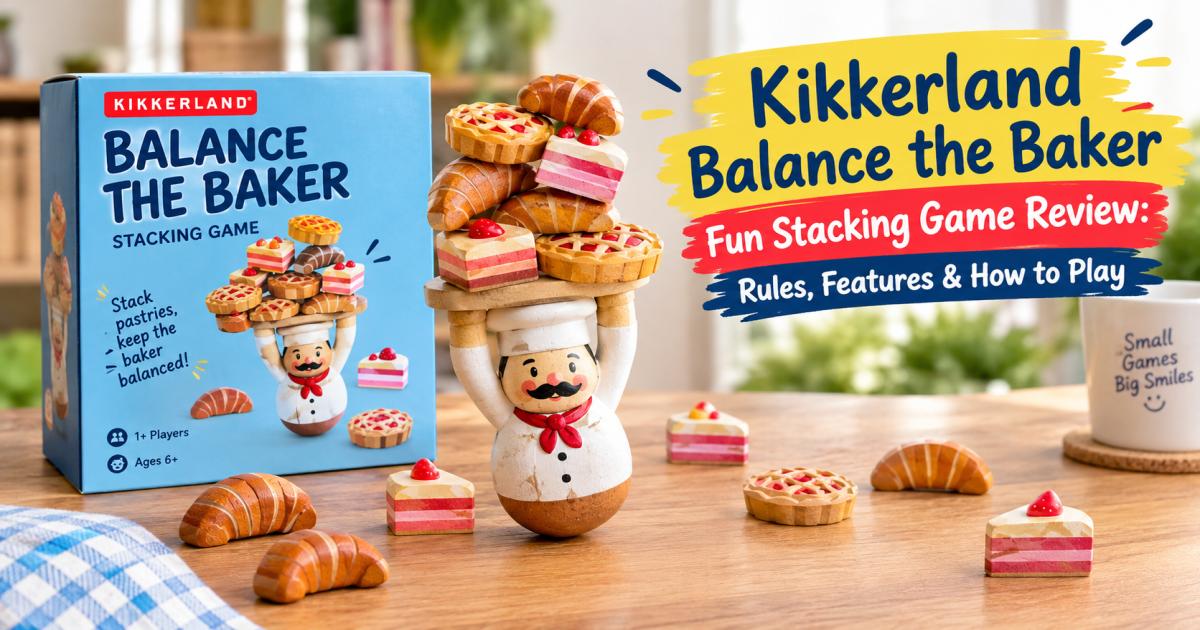
Kikkerland Balance the Baker Fun Stacking Game Review: Rules, Features & How to Play
The Kikkerland Balance the Baker Fun Stacking Game is a small wooden game where players take turns piling pies, cakes, and croissants onto a baker without letting the load fall. Retailers list it for ages 4 and up, and the materials are beechwood and cotton. One person can play it alone, or a group can play it in short rounds. New copies cost roughly $10 to $23, depending on the store.
Is it worth buying? At the low end of that price range, yes. At the high end, it’s still a fair gift, but compare stores first.
This review covers what’s in the box, how to play, the rules, pros and cons, and who should buy it. It draws on product listings from museum shops, a Swiss toy retailer, a university bookstore, and used-market sales. We also compared it with Kikkerland’s other stacking games. Where we describe play, we base it on the game’s design and on how stacking games like it typically work. Where stores disagree on size or price, we show both numbers.
What Is the Kikkerland Balance the Baker Fun Stacking Game?
Picture a tiny baker with a tray that’s already too full. Your job is to add one more treat and pass the turn. The more you add, the shakier it gets.
Kikkerland is a New York City design company, founded in 1992 by Dutch designer Jan van der Lande, and it’s known for playful everyday products. Balance the Baker fits that style. It’s cute, simple, and nice enough to leave on a shelf.
So what kind of game is it? It’s a wooden balance game, or stacking game, where steady hands matter more than luck. One Swiss retailer calls it a skill game for children that supports focus and fine motor control. Adults can enjoy it too, since the rules fit in a single sentence.
One quick warning for shoppers: this is not “Mickey the Balancing Baker.” That’s a separate 1990 Milton Bradley game for two players. Look for the Kikkerland name.
Kikkerland Balance the Baker at a Glance
| Detail | What listings say |
| Maker | Kikkerland |
| Type | Wooden stacking and balance game |
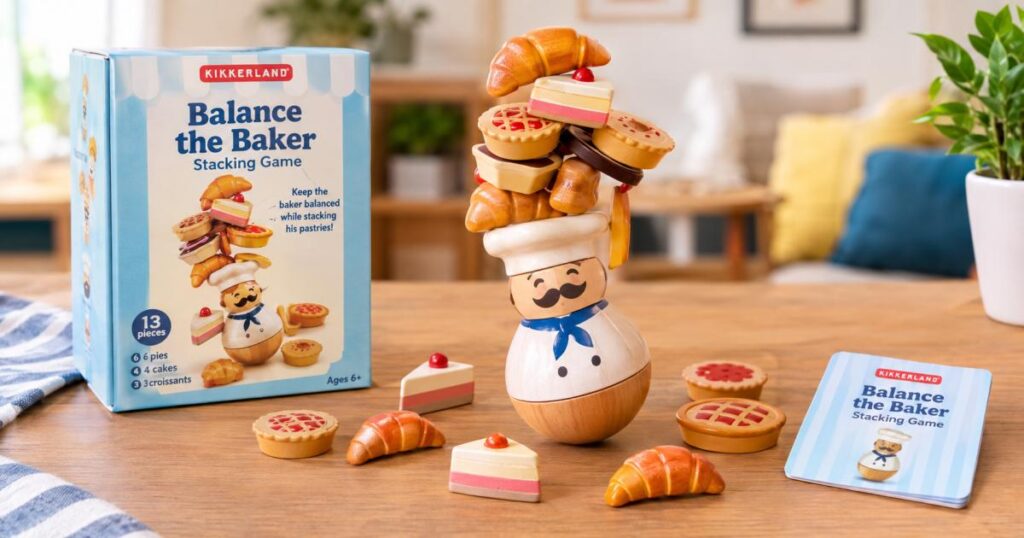
| Pieces | Pie, cake, and croissant pieces, plus the Baker |
| Materials | Beechwood and cotton |
| Recommended age | 4 and up |
| Players | Family play, group play, or solo play |
| Size (most US listings) | About 12.2 x 9 x 6.6 cm, or roughly 4.8 x 3.5 x 2.6 inches |
| Size (one Swiss listing) | 14 x 14 x 7.5 cm |
| Packaging | Color box |
| New price | About $10 to $23 |
Two details are worth a closer look, and we’ll come back to them. The first is the price spread. One museum shop page lists it at $10, while another page on the same shop’s site shows $19.50, and a different museum store charges $23. The second is the size mismatch between stores. The game is small either way. Still, check the exact listing before you buy.
What Comes in the Balance the Baker Game?
Here’s what the listings show. None of the pages we found gives an exact piece count, so check the box or the store page if that number matters to you.
The Wooden Baker
The baker is the star. He carries the load, and the whole game is about keeping him steady. Players stack pastries alternately on his trays. You’re building on a base that was never meant to hold a giant pile. That gap between “holds a few” and “holds too many” is where the fun lives.
Pastries, Cakes, and Croissants
The set includes pie, cake, and croissant pieces. Different shapes act differently. A flat piece usually sits steadier than a curved one, so picking the right piece for the moment is half the strategy.
Packaging and Overall Build
The game ships in a color box. It’s small enough to slip into a bag. Listings name cotton as a material but don’t say which part uses it, so check the product photos if you’re curious.
A note on safety: retailers recommend ages 4 and up. For comparison, Kikkerland’s Don’t Tip the Waiter carries a choking-hazard warning for children under 3. Small wooden pieces are small wooden pieces, so keep this game away from toddlers and read the warning on your own box.
How to Play Kikkerland Balance the Baker
How do you play Balance the Baker? You set the baker on a flat table, take turns adding one pastry at a time, and avoid the crash. Here’s each step in order.
Step 1 — Set Up the Baker
Put the baker on a flat, hard surface, like a table or a wood floor. Soft spots such as couches, rugs, and bed covers make the game much harder than it should be. Spread the pastries within reach of everyone.
Step 2 — Decide Who Goes First
Let the youngest player start, or use rock-paper-scissors. Turn order matters a little, because the first few turns feel easy and the last few feel tense.
Step 3 — Take Turns Adding Pastries
On your turn, pick one piece and place it on the baker’s load. The core idea is that players take turns stacking pastries. Lower the piece slowly and let it settle before you pull your fingers away.
Step 4 — Keep the Baker Balanced
Look at the whole load before you place anything. If the left tray is crowded, add to the right. A quick look from the side often shows a lean you’d miss from above.
Step 5 — What Happens When the Pastries Fall?
When the load falls, the round ends. The player who made the last placement loses that round. Reset the baker and go again. Rounds are short, so most groups will want a rematch.
Kikkerland Balance the Baker Rules Explained
What are the rules of Balance the Baker? The listings state one rule: take turns adding pastries and don’t let the baker drop everything. We couldn’t find a full printed rulebook online. The rules below stay close to that core rule and fill in the details most groups need.
The Basic Stacking Rule
Each player adds one piece per turn. You can’t skip, and you can’t move pieces that are already placed. Your hands only touch the piece you’re adding.
The Balance Rule
Your piece counts only if it stays up after you let go. If it holds only while you touch it, it doesn’t count. Count to three after you release.
The Falling-Pastry Rule
If any piece falls or the baker tips, the round ends. The person who placed the last piece takes the loss. If several pieces fall at once, blame the last hand that touched the stack.
How to Determine the Winner
For a quick game, the last player to place a piece without a crash wins the round. For a longer game, play best of three or best of five. The overall winner is the player with the most round wins.
Optional House Rules for More Fun
- Blind pick: Draw pieces from a bag and place whatever you get.
- Timer turns: Give each player ten seconds.
- Weak hand only: Place pieces with your other hand.
- Team mode: Two teams share one stack.
- Solo score: Count how many pieces you place before the first fall, then try to beat that number.
Kikkerland Balance the Baker Features
Wooden Construction and Materials
The game is made of beechwood and cotton. Beech is typically a dense hardwood, and toy makers often choose it for durability. Wood also tends to grip better than smooth plastic, which helps stacked pieces stay put.
Wobbly Baker Design
Is the baker wobbly? Expect a little wobble, and that’s the point. In any balance game, the base can’t hold a perfect stack forever. The trays and the odd shapes of the pastries create the challenge.
Pastry-Themed Pieces
The pie, cake, and croissant pieces give the game more charm than plain blocks. Kids typically like pretend-play themes, and the bakery idea adds a story to each round. Adults get a cute desk piece when the game ends.
Compact Size and Storage
At about 12.2 x 9 x 6.6 cm, the box fits in a purse, a diaper bag, or a carry-on. That makes it handy for restaurants, waiting rooms, and trips. If you buy from a store that lists a larger size, the game may still be about the same, since listings differ.
Solo and Multiplayer Potential
Retailer copy says the game works for family game nights, social gatherings, and solo play. Alone, you play against your best score. With others, you play for the win. Few small games switch between the two so easily.
Skills You Can Practice While Playing
Hand-Eye Coordination
You judge the gap, aim, and place. Retailer copy names hand-eye coordination as a skill the game builds. Repeat that loop a few dozen times, and your aim usually improves.
Fine Motor Skills
Picking up a small piece and setting it down gently uses the small muscles in your fingers. Stacking tasks are a common way to practice hand control, the same control kids use for writing and buttoning a shirt.
Patience and Concentration
A rushed placement tends to end a round fast. The game rewards slow, careful moves, so kids practice waiting and focusing on one task.
Spatial Awareness and Balance
Where does the weight sit? Which way will the pile lean? Players start to feel balance without anyone naming it. That’s a real science idea, center of gravity, hiding inside a bakery game.
Strategic Thinking and Problem-Solving
You also think about the next player. A smart placement leaves them in a tricky spot. Older kids and adults often pick up on this quickly.
Kikkerland Balance the Baker Gameplay: What Is It Actually Like?
These notes come from the game’s design and how this style of game typically plays. Your table, your pieces, and your group may change the feel.
Is It Easy to Learn?
Yes. The goal fits in one sentence, and there’s nothing to read. After one demo round, most four-year-olds should follow along, and adults can start right away.
Is It Challenging?
It gets harder as the stack grows. Early turns are relaxed, and late turns are tense. The challenge builds by itself, so you don’t need extra rules to keep it fresh.
How Much Does Luck Matter?
Less than in most dice games. Table shake and piece choice play a part, but careful placement usually wins out. This is a steady-hands game.
Is It More Fun Alone or With Others?
Both work, and they feel different. Alone, it’s calm, like a small puzzle. With a group, it’s louder, with groans and laughs. Most people will likely enjoy the group version more.
How Does the Wobbling Affect the Experience?
Wobble builds tension. Everyone leans in and goes quiet. The moment a piece slips is often the funniest part of the round.
Kikkerland Balance the Baker Review: Pros and Cons
What We Like
- Rules that take under two minutes to explain
- Small box that travels well
- Wooden pieces with a bakery theme
- Works alone or with a group
- A low price at many stores
- Good practice for focus and hand control
What Could Be Better
- No full rulebook found in online listings
- No clear piece count in the listings we saw
- Prices range from about $10 to $23, and listed sizes differ by store
- Small pieces need supervision with young kids
- Less long-term depth than bigger games
- Some stores show it as sold out
Who Is Kikkerland Balance the Baker Best For?
For Kids and Families
With a listed age of 4 and up, it suits preschoolers and early grade-schoolers. Younger kids will need help. Older kids can try the harder house rules.
For Adults and Casual Gamers
If you like quick, silly games, you’ll likely enjoy it. It’s not a deep strategy game, but it works well as a warm-up before a bigger one.
For Parties and Social Gatherings
The rules are short, rounds are fast, and losing is funny. That mix tends to work well for ice-breakers.
For Gift Giving
The small size and cute packaging make it an easy gift for birthdays, classroom prizes, or stockings. Because the price runs from about $10 to $23, compare stores first. Also note that some used-market sellers tag the game as “Montessori.” That label appears in seller titles on eBay. It’s the seller’s wording, not a claim from Kikkerland.
For Solo Players
If you want a calm break at your desk, set a personal best and try to beat it.
Kikkerland Balance the Baker vs. Other Stacking Games
Balance the Baker vs. Don’t Tip the Waiter
Both are Kikkerland wooden games. In Don’t Tip the Waiter, you balance small items on a waiter’s hands. It’s listed for two or more players, ages 6 and up, and made of beechwood and plywood. One nonprofit store lists it at $24.99.
Differences in Theme and Gameplay
- Balance the Baker: A baker, trays, and pastries. Listed for ages 4 and up, with solo play mentioned.
- Don’t Tip the Waiter: A waiter’s hands and varied items. A higher age rating, with a group focus.
- Teeter Totter shapes: One US store lists it for two or more players, ages 6 and up, while a UK store lists 11 wooden shapes for ages 3 and up and asks for adult supervision because some shapes are small.
- Stack-A-Bug: A bug-themed set with 42 wooden blocks and a die.
Notice how age ratings change by store. Always check the box and the safety notes.
Which Type of Player Would Prefer Each Game?
Choose Balance the Baker for younger kids, a solo option, and a lower typical price. Choose Don’t Tip the Waiter for older kids and bigger groups. Choose Teeter Totter if you like colorful shapes and open-ended play.
Tips and Tricks for Winning Balance the Baker
Start With a Stable Placement
Place wide, flat pieces early. They give later turns a base. Save odd shapes for when the stack is steady.
Watch the Baker’s Balance
Check the lean before every move. A stack stays up when its weight sits over its base, so a small tilt grows fast. If the baker leans left, place your piece on the right.
Distribute Weight Carefully
Spread pieces out. Think “wide and low,” not “tall and thin.” For example, if the first two pieces went on the left tray, favor the right tray next.
Place Pieces Slowly and Precisely
Lower the piece, let it rest, and then lift your fingers one at a time. A rushed release is a common cause of a crash.
Is Kikkerland Balance the Baker Worth Buying?
For most people, yes, if the price is near the low end. At about $10, it’s an easy buy. At $23, it still works as a gift, but you may want to compare. Used copies show up as well. One used copy sold for $13.50 plus $6.50 shipping, and another was listed at $16.99. Shipping can erase the savings, so add it up before you decide. A new copy also has an easier return path. One university bookstore accepts returns within 30 days with a receipt.
Skip it if you want a deep game that lasts for hours. This one is short and light. It works best in small moments, such as a restaurant wait, a quiet evening, or a classroom treat.
Final Verdict
Yes. It’s simple, cute, and quick to learn. The wood build, bakery theme, and solo option set it apart from many basic block games. Its limits are short play time, unclear piece counts, and a price and size that vary by store. For families with kids 4 and up, it’s a good small buy.
FAQs
What is Kikkerland Balance the Baker?
It’s a small wooden stacking game from Kikkerland. Players take turns placing pies, cakes, and croissants on a baker, and the round ends when the load falls. The listed materials are beechwood and cotton.
How do you play Balance the Baker?
Set the baker on a flat table. Take turns adding one pastry at a time, and keep the load balanced. The player who makes the stack fall loses the round. Play several rounds and count wins to find the overall winner.
What pieces are included in Balance the Baker?
Listings name pie, cake, and croissant pieces. The baker is part of the set. None of the listings we found give an exact piece count, so check the box or store page.
Is Balance the Baker a game for one person?
Yes. Retailer copy says it works for solo play as well as group play. Set a goal for how many pieces you can place before a fall, then try to beat it.
What is Kikkerland Balance the Baker made of?
The listed materials are beechwood and cotton. Listings don’t say which part is cotton, so check the product photos.
What are the dimensions of the game?
Most US listings give 12.2 x 9 x 6.6 cm, or about 4.8 x 3.5 x 2.6 inches. One Swiss store lists 14 x 14 x 7.5 cm. Check the page of the store you buy from.
Is Balance the Baker good for families?
Yes. It’s listed for ages 4 and up; the rules are short, and rounds are quick. Supervise young children, since the pieces are small. For a price check, expect about $10 to $23 for a new copy.
Final Takeaway
The Kikkerland Balance the Baker fun stacking game is a small, cheerful wooden game that proves simple can work. It builds steady hands, patience, and a feel for balance. It packs small, plays fast, and usually costs less than most wooden games. Check the price and listed size before you buy, keep it away from toddlers, and enjoy the laughs when the pastries fall.